Buyers of Texas new homes often organize electricity, internet and moving services before closing. Mail delivery deserves its own place on that schedule. A finished house, an installed mailbox and a set of keys do not necessarily establish that postal service is ready.
The practical task is to identify which arrangements are complete and which still need attention. Address verification, mailbox assignment, resident access and the start of delivery involve different questions.
Alongside your new-construction home inspection checklist, set aside time to confirm how you will receive letters and packages after moving in.
Locate the Mailbox Assigned to Your Home
Start by asking the builder where your household will collect mail.
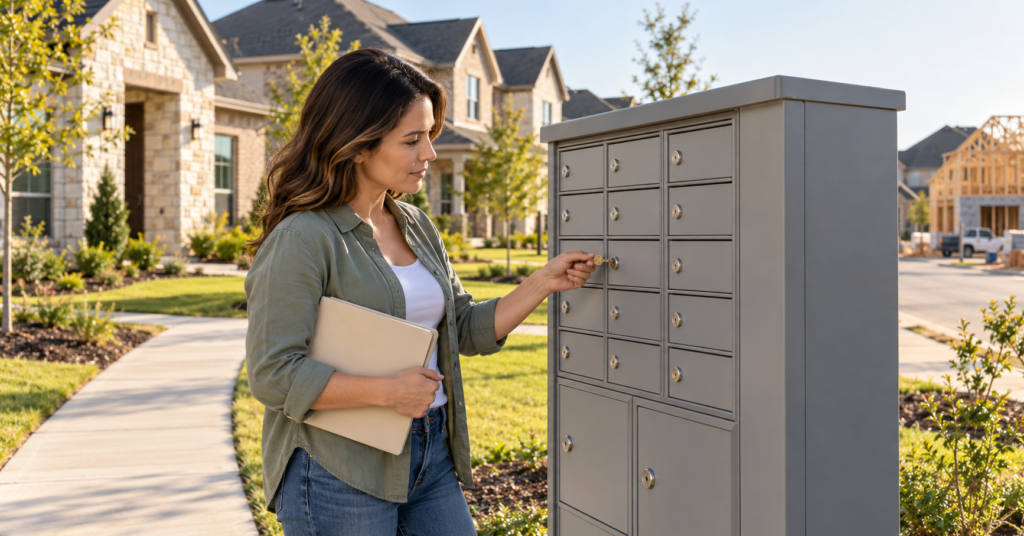
USPS determines the delivery method for new developments, including the mailbox type and location. Centralized delivery is its preferred arrangement for new addresses, so a newly built house may use a shared cluster box rather than an individual curbside mailbox.
Request the location of the correct cluster unit and your assigned compartment number. In a development with several mailbox banks, directions such as “near the entrance” may be insufficient.
Visit the location with the builder’s representative if possible. Compare the assignment with the handover paperwork and keep a photograph showing the unit’s location.
Do not choose an apparently empty compartment yourself. If the assignment is missing or inconsistent, have the responsible contact resolve it before you begin using the box.
Verify the Postal Address Early
Use the assigned street address when discussing service, rather than relying on a builder’s lot number or marketing name.
Local governments create new street addresses, and USPS provides a process for reporting new construction. Its guidance directs customers to the local Post Office or its Growth Management Assistance Request form when reporting a new address.
Compare the house number, street name, directional designation and any required unit information across your documents. If those details conflict, ask the builder to identify the official assignment and resolve the discrepancy with the appropriate addressing authority.
When contacting USPS, explain that the property is newly constructed. Ask whether the address has been verified and whether anything remains outstanding.
Keep a record of the response. An address correction is easier to follow up when you can provide the exact wording previously submitted.
Establish Who Will Supply the Keys
Mailbox ownership affects whom you should contact for access.
For privately owned cluster boxes, USPS identifies the builder or property owner as responsible for lock and key service. For Postal Service-owned cluster boxes, USPS provides the customer’s compartment lock and keys. Confirm which arrangement applies to your development.
Before handover, establish:
- Where and when you can collect the keys.
- What identification or occupancy documentation to bring.
- Whether any charge applies and what it covers.
- Whom to contact if a supplied key does not work.
Test the keys in your assigned compartment during handover when access is available. Check that the door opens, closes and locks properly.
If the lock sticks, report the problem to the responsible party. Avoid forcing it or arranging an alteration before confirming who owns and maintains the equipment.
Separate Resident Access From the Delivery Start Date
Your compartment key and the carrier’s access mechanism serve different purposes.
USPS supplies a master access lock that allows its carriers to deliver mail into centralized equipment. Its planning guidance states that developers and builders cannot pre-install this lock; installation is coordinated through USPS as part of starting service.
This distinction explains why receiving a working resident key is not, by itself, proof that delivery has begun.
Ask the builder what remains incomplete, then confirm the service status with the Post Office serving the address. Request a specific explanation if the answer is simply “waiting for USPS.”
For example, determine whether the outstanding issue concerns carrier access, address verification or another delivery arrangement. Record any estimated completion date as an estimate until the responsible party confirms that service is operating.
Check Access Around Ongoing Construction
An operational mailbox still needs a usable approach. USPS guidance requires customers to keep mailbox approaches and adjacent areas clear so carriers can deliver safely.
Walk the route you will use to collect mail. Look for construction fencing, stored materials, parked contractor vehicles or unfinished paths that interfere with access.
Report the precise location and take a photograph if it helps explain the problem. Ask the builder or community manager who will keep the area accessible while nearby homes remain under construction.
If you have mobility-related access needs, raise them before moving day so the relevant parties can discuss the location and available arrangements. Do not assume that an informal route through a construction area will remain available.
Agree on Temporary Collection Arrangements
If delivery will not be ready when you move in, contact the serving Post Office before sending important items to the new address.
Ask whether it can provide a temporary collection arrangement or recommend another suitable option. Do not assume that undeliverable mail will automatically wait at the nearest postal counter.
Clarify the practical details:
- The exact collection location.
- Available pickup hours.
- Required identification.
- How mail must be addressed.
- How long the arrangement will remain available.
- What happens to uncollected items.
Ask about letters and packages separately so you understand the scope of the arrangement.
For example, a collection point that closes before you finish work may require a different plan. Resolve that scheduling problem before directing replacement bank cards, original documents or other time-sensitive items there.
Coordinate Forwarding With Important Senders
A change-of-address request handles forwarding from a previous address. Mailbox equipment and delivery arrangements at the new property still need their own confirmation.
USPS advises people filing an in-person change of address to identify the destination as new construction so the serving Post Office can take any necessary verification steps. USPS also explains that some mail may not forward because of the sender’s instructions.
Update essential senders directly, including financial institutions, insurers, employers and subscription providers. For an item already in transit, contact its sender about available options rather than assuming an address update will redirect it.
Keep the forwarding confirmation and check its start date against your move schedule. If closing changes, review the request promptly.
Plan Private Courier Deliveries Separately
Confirm delivery instructions with each private courier or retailer you use. Do not assume that a USPS cluster-box assignment also provides access to a community package room or another delivery company’s locker system.
Ask the builder or community manager about gate access, delivery entrances and any separate parcel facilities. For a home in a partially completed subdivision, accurate directions and visible house numbering can also help explain the destination.
Check the carrier shown in tracking information before reporting a missing package. A successful doorstep delivery by one company does not confirm that USPS service is active, and a postal setup issue does not establish what happened to another carrier’s shipment.
For valuable or urgent purchases, confirm an available delivery or collection option before ordering.
Note: Arrangements vary by address and development. Consult the USPS guidance for establishing delivery at new locations and confirm your property’s status with the Post Office serving it.